The Hours That Matter Most
For many young people in London, the time between the school bell and the front door closing is where things can go wrong. Youth facilities spending fell by 73% between 2010 and 2023. The UK ranks last out of 27 European countries for how happy 15-year-olds feel about their lives. Nearly half of all young people spend the majority of their spare time alone in their bedroom.
These statistics are the driving motivations to every session TackleLondon delivers.
Jonathan, 15, knows that backdrop well. Before rugby, he describes drifting into situations he shouldn’t have been in. Not because he was a bad kid, but because the structured, safe spaces that might have caught him simply weren’t there.
What rugby gave Jonathan wasn’t a solution to his problems. It gave him something perhaps more valuable: a place to be known.
Jonathan’s mum, Elaine, describes the effect with a simplicity that says everything:
The Importance of Being Heard Before Problem Solving
Dr. Amy Atkinson, TackleLondon’s Education and Schools Manager, works at the intersection of sport, trauma and young people’s wellbeing every day. She is under no illusion about the landscape young Londoners are navigating.
TackleLondon’s response to that reality is not to diagnose or to counsel. It is to create an environment where a young person doesn’t have to perform being okay. Where a coach noticing that someone is quieter than usual is not an intrusion, it’s just what happens when you’re known. That is the mental health intervention we are capable of delivering. And the evidence suggests it matters enormously. Jonathan himself describes how rugby gave him something he could carry into every part of his life:
Learning to pause. Learning to breathe. Learning that a moment of calm is available to you. These are not small things for a 15-year-old under pressure.
What Consistency Does
‘John’ – whose name we’ve changed to protect his privacy – first picked up a rugby ball in a Year 8 PE lesson. There was nothing dramatic about the moment. But what followed was years of consistent support that grew alongside him.
By Year 10, John was captaining his school’s 7s team, earning his Bronze Duke of Edinburgh award, and considering the Matt Ratana Rugby Foundation Academy. Not because TackleLondon mapped out his future. But because the same coaches, the same structure, and the same belief were waiting for him every single week.
His story speaks to something we believe deeply: that mental wellbeing isn’t usually built in a single breakthrough. It’s built in the accumulation of ordinary moments – a coach who remembers your name, a team who expects you to turn up, a routine that gives shape to your week.
John’s story is not about elite sport. It is about what can happen when a young person has:
- Consistency they can rely on
- Adults who show up every week
- A safe space after school
- A community that keeps them grounded, engaged and proud of who they are becoming
Anger Is Not the Enemy
Max came to TackleLondon carrying a story most of us will never fully understand. A rare kidney condition had taken years of his childhood – hospitals, isolation, missed milestones. By the time he arrived at Staines RFC through an Alternative Provision programme, his emotions were close to the surface. Frustration was his first line of defence.
His coaches at Staines didn’t try to eliminate his anger. They worked with it. Patiently. Week after week.
Max’s mum has watched this transformation more closely than anyone:
Max didn’t need ‘fixing’. He needed patience, structure, and people who believed in him consistently enough for that belief to become his own.
Girls, Belonging, and the Confidence to Take Up Space
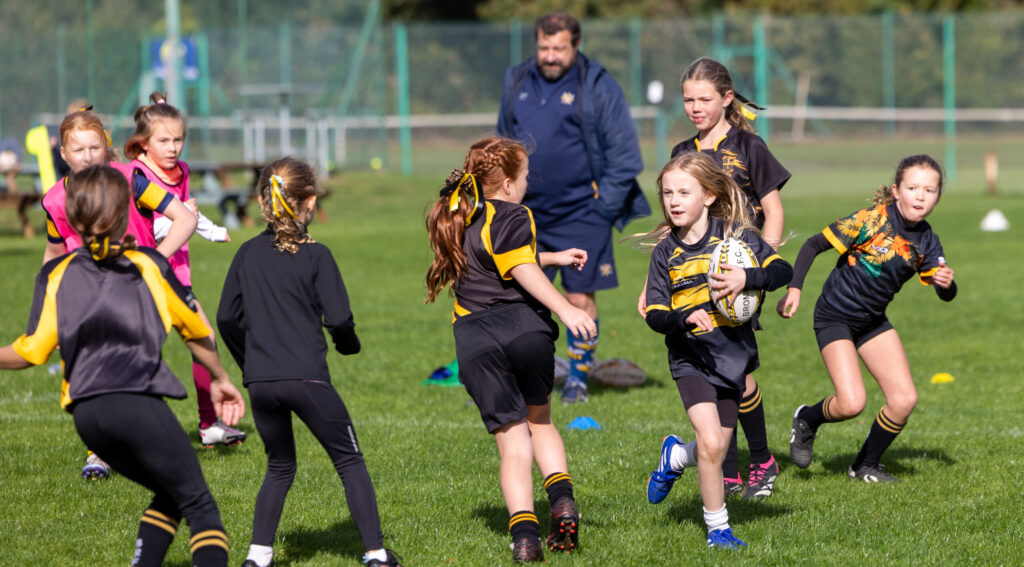
Mental wellbeing doesn’t look the same for everyone. For many of the young women we work with, the challenge is less about managing anger and more about invisibility: feeling that sport, confidence, and belonging simply aren’t for them.
This year, TackleLondon’s in-school coaching data showed consistent growth in confidence, emotional regulation and self-belief across our sessions, and in many cases, these gains were most visible in girls. Young women described by teachers as withdrawn or disengaged were stepping forward. Taking space. Leading.
Feedback from Chislehurst School for Girls captured it directly:
And from another school:
These are observations about how young people feel in those sessions. Valued. Included. Capable.
The Camaraderie That Can’t Be Manufactured
This year, TackleLondon launched its Matt Ratana Development Academy, initially bringing together 25 young people from seven schools across Croydon and Bromley for a midweek training session at Croydon RFC. Some were committed rugby players. Some were footballers giving something new a go.
TackleLondon coach Aidan Brennan described what he saw take shape in just two weeks:
Coach Billy Davis reflected on what the Academy represents beyond the rugby itself:
Belonging. That word keeps coming back. Because at the heart of mental wellbeing, for young people and adults alike, is the knowledge that there is somewhere you are expected. Somewhere that would notice if you didn’t show up.
What This Week Is About
Mental Health Awareness Week is not a week for TackleLondon to claim expertise we don’t have. We are not a mental health service. We are a rugby organisation for young people. But what we’ve learned – through John and Jonathan and Max and the girls stepping onto pitches across South London – is that mental wellbeing is often built in the spaces between formal support.
It lives in the coach who asks “how was home this week?” And in the team that keeps a seat for you. It lives in the routine that makes Tuesday feel reliable when nothing else does.
If you know a young Londoner who could benefit from that kind of support – a consistent space, a patient adult, a team who will have them – please get in touch. We’re here. And we’ll keep showing up.
To refer a young person to TackleLondon, visit tacklelondon.org/referrals
To find out more about our work or to support us, visit tacklelondon.org
If you or a young person you know needs urgent mental health support, please contact the Young Minds Crisis Messenger (text YM to 85258, free 24/7) or visit your GP.